Scattershot AI use cases do not build
an AI-enabled enterprise. I help leaders establish
the Enterprise AI Operating Model.
BHARATKHANDELWAL

Thirty Years Leading Change

I have led change in four conditions: planned and unplanned, slow and fast.

I started with large technology programs, moved into transactions, then spent more than a decade leading business transformations. Today, I am applying that experience to AI: helping leaders move from experiments to operating capability.

The Change Lens

SlowTime to sequence, align, and absorb.
FastReaction time matters; decisions compress.
PlannedThe organization can prepare.
Planned changeLarge programs with budgets, teams, timelines, and governance.
Rapid deliberate changeChosen before the market forces it, with fast learning and reversibility.
UnplannedMost people meet it as surprise.
Market-driven changeSignals build slowly, but the response often starts late.
Unplanned changeTransactions, shocks, and decisions before consensus.
10+ companiesERP and digital platforms across global organizations.
~25 dealsStrategy, integration, carve-out, and synergy realization.
$1B+ gainsFive transformations across a $15B+ revenue base.
$3B brandInterim CDIO, reducing tech spend 20% while accelerating delivery.
Experience

Four kinds of change I have led

Planned + slow

Planned change (Technology)

Sequenced · Budgeted · Cross-functional

Scarce resource: Perseverance.

Nature: Chosen, funded, and announced, but hard because systems, functions, countries, and people must move together.

Experience: 1995-2004: ERP and digital platforms across 10+ global companies, including programs that were delayed, over budget, or organizationally misaligned.

Unplanned + fast

Unplanned change (Transactions)

Surprising · Political · Decisive

Scarce resource: Judgment.

Nature: Change arrives before most people have context. Power shifts, roles blur, jobs are at stake, and decisions come before consensus.

Experience: 2004-2011: a founding member of EY's Strategy and Transaction Practice, later at Deloitte, advising on ~25 global transactions across strategy, integration, carve-out, and synergy realization.

Unplanned + slow

Market-driven change (Transformation)

Delayed · Adaptive · Competitive

Scarce resource: Leadership.

Nature: Market signals build over years, but legacy habits make the response late and difficult. The company must learn a new model while still performing.

Experience: 2011-2025: built BCG's US Fashion & Retail Sector, led a ~100-person team, and drove $1B+ operating margin gains across five global companies over a $15B+ revenue base.

Planned + fast

Rapid deliberate change (AI)

Experimental · Governed · Reversible

Scarce resource: Reversibility.

Nature: AI moves faster than traditional transformation can absorb. Leaders need speed, governance, trust systems, and workflow redesign at the same time.

Experience: 2025-present: Interim CDIO for a ~$3B public company, reducing technology spend 20% while accelerating digital delivery, plus live AI products, trusted-answer systems, evaluation layers, and Enterprise AI Operating Model work.

Ambition To Action

The work also became a book. Ambition to Action is my completed manuscript on transformative change, built from thirty years of field experience and research across psychology, sociology, behavioral economics, and organizational change.

Ask-A2A is the companion system. It is a graph RAG engine over the book, the research base, and the practical lessons behind it, so the ideas can be questioned, sourced, and applied.

The Point

AI is the next change test. It can be planned now, while leaders still have room to build capability, or it can arrive later as unplanned disruption. The lesson from every prior wave is simple: the organizations that move early learn faster, absorb more, and make better decisions under pressure.

Planned change

1995 – 2004 · Technology
THE PLAN THE ROLLOUT

The nature of change. The first decade was planned change. Large-scale ERP swept the world, and for the first time siloed functional processes were brought together. This is change an organization chooses, budgets, and announces, with positive ambition and clear blueprints. It stays hard even so: no plan survives ten countries intact.

The work. Grew from consultant to program lead at Intelligroup, implementing ERP and digital platforms across 10+ global companies. Built a reputation for salvaging programs that were delayed, over budget, or organizationally misaligned.

The reflection. Change at this scale means aligning people across silos and cultures. Status quo bias yields to small wins and steady momentum, not to mandates. The scarce resource is perseverance, tested most in the middle when the work still looks like failure.

Unplanned change

2004 – 2011 · Transactions
DECIDE BEFORE CONSENSUS

The nature of change. The second decade was unplanned change. Companies merge, and the deal is known only at the top. Middle and even senior management are caught by surprise. From the outset it is clear that jobs will be lost, most of them senior. People jockey for power, politics runs hot, and cost-cutting is a given. Change without consensus, at speed.

The work. A founding member of EY's strategy and transaction practice, and later at Deloitte, advising on ~25 global transactions across the deal cycle: strategy, integration, carve-out, synergy realization. From Italy to China to Japan.

The reflection. The biggest loss in a merger is tacit knowledge, which leaves with the people who go. Protecting it means keeping the best of both firms and forging one culture from two. The scarce resource is judgment, made at speed and without consensus.

Forced change

2011 – 2025 · Transformations
REBUILD, STILL SAILING

The nature of change. The third wave was forced change, driven by the market. Legacy companies were caught unaware as digital marketing, e-commerce, and data and analytics became the main tools of the trade. Retail and consumer businesses moved from wholesale to e-commerce. This was the digital transformation era, and what changed was not a process but the business model itself.

The work. Led the creation of BCG’s US Fashion & Retail Sector business, creating a ~100 people team, out maneuvering the competition, and driving significant client value. Led transformations for five global companies, which collectively drove $1B+ in operating margin gains (over a revenue base of $15B+). Two of these companies have increased market cap by 4X and 3X.

The reflection. Transformation on this scale succeeds only when CEOs and senior executives lead it from the front. It demands speed and a genuine willingness to learn new business models and technologies. The scarce resource is leadership by example, ready to import skills the organization cannot grow itself.

Rapid change

2026 – Present · AI
1 2 3 4 FOUR WAVES, ONE BRAID

The nature of change. The fourth wave is rapid change, unleashed by AI. Its defining feature is speed: change now compounds exponentially. Its impact is asymmetric, rewarding those who embrace the tools and leaving the rest behind. The deeper change is not a tool bolted onto the business but a rewiring of it, where information once locked inside is democratized for decisions. It is the most complex change of the four, and it is additive: every prior wave is still in the braid.

The work. Building and experimenting across the AI stack, from the model to the boardroom (Work with AI). It has produced live products such as napkinsolo.ai and the engine behind anti-library.ai (Products), plus an AIOS framework for adopting AI across an organization.

The reflection. This period rewards rapid experimentation and iteration with emerging technology. Progress comes from reversing what fails, quickly and without attachment. The scarce resource is the readiness to walk away from sunk cost.

From the token to the boardroom

The whole AI stack, built and run live.

Operating doctrine

AI compounds only when it changes how the company works

The claim I build AI-based operating models that turn scattered experiments into enterprise capability.

Most companies begin with use cases, copilots, and chat licenses. The harder work is building the AI operating system underneath: making the organization machine-legible, preparing workflows for agents, and defining how trust, decisions, and accountability work when humans and machines share decisions.

I bring systems thinking, decades of transformation experience, and hands-on AI depth across product, architecture, evaluation, and deployment.

Knowledge systemsGraph RAG, authored corpora, retrieval, reranking, and cited answers.Make enterprise knowledge queryable, traceable, and useful for decisions.
Trust systemsEvaluation layers, seeded defects, fabrication checks, human gates, and telemetry.Trust is engineered through judgment and protection, not assigned to the model.
Operating modelAIOS, Navik, workflow redesign, agent accountability, and governance as a spine.Value accrues when AI changes how work, decisions, and responsibility move.
The force

Like the industrial revolution, AI will unleash massive change, with three differences

SkillsThe industrial revolution mechanized the production of goods, but specialization and skills kept their value. AI automates, augments, and even eliminates intellectual and creative tasks.Embrace the silo-busting as agents scour everything in the servers and get better than humans at decisions, as happened with chess; the role of managers and office workers changes.
PaceSteam power, electricity, and machines gave people decades to adjust. AI adoption will be compressed, with the motivated few taking an enormous lead.Experiment at pace, walk away from the sunk costs of failed experiments, and switch rapidly to improved tools.
PeopleThe industrial revolution moved labor, but apprenticeship and mentorship still carried knowledge from master to apprentice. AI makes that transfer opaque, and tacit knowledge shrinks.Develop operating models where the human ability to judge, critique, and act is preserved even as direct experience keeps reducing, like the ability to read a paper map.
Core capabilities

Eight capabilities, learned by building

1 · The Model

Task-fit intelligence

BuiltWorked hands-on across every model type: large and small language models, vision, embedding, and OCR, including open-weight models run locally on my own Mac (a Qwen vision model and a 30-billion-parameter Qwen). Each system was built around the one that fit the task, not the biggest available.
StudiesRead a 189-book shelf with five open-weight vision models, same prompt and scoring, changing only the model. The biggest model was not the most accurate, and what separated a safe model from a risky one was its fabrication rate (how often it invented a book that wasn't there), not its raw score.
LearnedChoose a model by the task and by how it fails, not by its size or its score. The biggest model is not the safest: one that fabricates confidently is more dangerous than a smaller one that admits it doesn't know.

2 · The Engine

Deterministic, hybrid, traceable

Builtanti-library.ai turns my ~1,200-book personal library into clusters of books that share ideas. Ask an LLM to build those clusters and it draws them differently every time. So I built the clustering engine as a hybrid: the LLM reads the ideas, but deterministic rules and vector similarity form the clusters, so the same input returns the same, traceable result every run.
StudiesI put the pure LLM and the hybrid side by side and measured how far the clusters moved between runs. The LLM's moved constantly; the hybrid's did not move at all.
LearnedReliability is not something you can prompt out of a model; it is something you engineer around it. A frontier model will not hand you dependability. The structure you build will.
Field reportWhen similarity became geometry — why a frontier model could not group thousands of claims reliably, and how an embedding model gave the search a fixed frame.

3 · The Lens

Coverage over canon

BuiltPoint an AI at a library, and it inherits three biases at once: it favors American authors, Western traditions, and famous names. I corrected this at the structural level: I designed a lattice drawn from international library classification systems, so coverage across geographies and traditions is enforced by design, keeping my own taste out of it.
StudiesOn top of that lattice I ran a farthest-first search that walks to the most distant, least-alike books first, so the periphery gets sampled before the canon. Tested blind against seven idea-threads I'd sealed in advance, it rediscovered five, where the earlier version, which ranked books by citation weight and Wikipedia legitimacy, had found none, and it turned up three threads I'd never named, one spanning Roman, Persian, Confucian, and Japanese traditions.
LearnedThe bias in AI discovery hides in the very signals that make things findable: citation weight, popularity, and canonical status all pull toward the same famous few, so any system that ranks by them will mistake fame for importance. To get complete and cosmopolitan answers, you have to deliberately seek out the distant and the less-legitimized, scouring the areas a fame-ranked system overlooks.

4 · The Harness

Metered, cheap, swappable

BuiltA demo that works once tells you nothing about what it costs to run every day. I rebuilt anti-library.ai behind a harness that logs every model call's tokens, cost, time, and GPU use to a single ledger, re-runs only the books that changed instead of the whole library, and treats the model as a swappable part, so a better one drops in as it arrives without rebuilding the system.
StudiesBecause every model call is metered to the ledger, I can see exactly where the cost concentrates and go after it. On Canon 100, a project that renders 100 major research papers into sketches, I cut the expensive drawing stage about ninefold, from a median of 105,000 tokens per paper to 11,000, by moving the ideation out of the drawing step and reusing work instead of regenerating it.
LearnedThe cost of a looping AI job is driven by the same context being repeatedly read. Modularizing and staging the work, plus smart use of caching, can significantly reduce costs.
Field reportHarness engineering: the system around the model — what building Antilibrary taught me about making production AI repeatable, auditable, and governable.
StudyWhere the Tokens Go — what 6,249 production calls taught me about tokens, caching, and prompt design.

5 · The Evaluator

Independent, layered, human-gated

BuiltBuilt Parakh, an evaluation layer that assays the work at every stage of anti-library.ai: collect, classify, churn, curate. Independent agents run checks at each step and evaluate the outcomes from different angles. Further, I added a human evaluation layer.
StudiesTo test the checker, I first planted a known false unit and confirmed it caught it, then ran it across 724 books and 3,468 idea-units. It flagged 26, including real fabrications the model had made up, like tagging one Dawkins book with the central metaphor of another.
LearnedTrust in AI has to be built through independent evaluation. AI hallucinates, and even a checker that checks the original work can have errors. A layered assay is important for catching errors and building trust. At the final stage, human-in-the-loop is still useful, particularly when dealing with problems where there isn't a deterministically correct answer.

6 · The Interface

Beautiful, clear, delightful

BuiltLagom restrains AI's synthetic, garrulous writing, refining ideas and words together toward a measured economy. A second system, AI and Beauty, draws on rules from four thinkers and nudges the AI into creating beautiful visuals on its own. And napkinsolo.ai turns complex material into something accessible and fun to read.
StudiesRather than prompt the AI for each visual, I wrote rules and let it draw on its own: one rule set from four thinkers on beauty, another for emergence that grew a book collection into a garden. The rules generated ideas and carried them at least 75% of the way to visuals that land with real wow; the rest I developed.
LearnedAI's ability to build taste, a sense of beauty, and aesthetics is still evolving. Yet AI can be nudged in the right direction with a set of simple rules rather than elaborate or restrictive prompts.

7 · The Trusted Answer

Graph RAG over a hand-built corpus, measured at every stage.

BuiltAsk-A2A, a graph RAG engine over my handbook Ambition to Action and the research base behind it. I rebuilt the corpus by hand: one idea per card, each card written to be found, each linked into a knowledge graph of concepts, researchers, and book passages. Retrieval is hybrid, reranked by a model, and expanded through the graph. The book frames each answer, the research supports it, and every source is shown.
StudiesReplaced 1,521 machine-cut chunks with 475 authored ones and measured the difference: concept cards went from 3.1 to 5.8 graph neighbors each, and none was left isolated. A listwise reranker raised mean reciprocal rank 24 percent and put the right source first on 82 percent of eval queries, up from 51. The stopwatch then found a surprise: the reranker spent 53 seconds thinking per call. Dialing its reasoning down cut that to 14, at a measured cost of five points of accuracy.
LearnedRAG quality is decided before retrieval. Chunks authored as single ideas beat clever search over scraped text. Downstream, every stage must earn its place twice, once on quality and once on the stopwatch: the stage that helped most was also the one that cost the most time.
Field reportGraph RAG: engineering answers you can trust — a case study: knowledge authored for retrieval, two engines with divided labor, and answers measured on quality and the clock.

8 · The Boardroom

Value accrues only when the operating model changes and AI becomes integral.

BuiltAn AIOS framework for adopting AI across an organization, past the usual list of short-term use cases. Reframed the board's question from use cases that pay off immediately to incrementally building a foundation that carries a decade of change. Mapped the new roles that emerge in an organization, and the work of managing agents alongside people.
StudiesAssessed how 10+ organizations outside technology and finance are adopting AI, and found nearly all stuck in one of two early stages: giving staff an assistant like Copilot or Claude, or buying select AI tools from vendors. None had begun to rebuild the company around a machine-readable operating system. The barrier was rarely technology; it was a lack of deep understanding and long-term view.
LearnedThe paradox: you need a long-term view, and fast, reversible experiments to get there. When technology is emerging fast, you have to get on the learning curve and yet walk away from the sunk costs of failed experiments.
Principles

How I build

The bar A capability counts only when I can build it and explain it from first principles.

On its own the model is unreliable, so the reliability has to come from the system around it. Measure every step, then improve by cutting whatever the data shows is dead weight. Ensure trust and quality through a multi-level assay system. Use human judgment where it matters.
Products

Everything here runs live.

(anti)library

Sanskrit · मन्थन manthan · to churn.
The cosmic ocean, churned until treasures rise.

anti-library.ai ↗

A library is a self-portrait. The AI engine takes you into its hidden depths.

It organizes your library flexibly, looks inside it, and makes serendipitous connections: a self-portrait of the reader, and a guide to what you might be missing. I used the project to learn the AI stack deeply, and to develop methods that de-bias AI outputs and create beauty.

MethodCollect · Classify · Churn · Curate · Consume
LearnedAI's bias comes from its training data. Every model type has comparative advantages and limits. Reliability on ambiguous problems comes from harness-based design, assay methods, and always-on telemetry.
StatusLive
FihristOpen source · from the engine

Arabic · الفهرست al-fihrist · the index.
Baghdad, 10th century: a catalogue of every book and author then known.

Fihrist is the open-source Python package for the World Lattice: a 3,660-leaf, ten-axis map for classifying books by what they are about, not where their authors are from. It ships the lattice, builds the enrichment and slotting prompts, and validates the model's answer — dropping invented leaves and flagging empty runs. The goal is finer, fairer classification for libraries that do not fit inside Western defaults.

Napkin-Solo

English · compound.
A napkin sketch, drawn alone.

napkinsolo.ai ↗

The hardest part of visual thinking is not the drawing. It is knowing what to draw.

Faced with a dense, difficult topic, we reach for a simplifying idea and draw it on a napkin. The engine works like the human mind: it digests difficult papers and ideas, and draws the napkin sketch that makes them land.

LearnedAI has real limits in thinking and explaining like a human; a thinking engine has to supplement the LLM. Better design cut token costs 10x.
StatusLive

Napkin Dōjō

Japanese · 道場 dōjō.
The place where you return, repeat, and the skill becomes yours.

We read a lot and remember little.

I love learning new words and ideas from across the world, so I built a flashcard app. The Dōjō is where you practice the best ideas, again and again, until knowing about them becomes knowing them.

LearnedThe power of AI for building small tools: the app was built from the ground up with Claude Code.
StatusLive

Ask-A2A

A graph RAG engine over a hand-built corpus.
Built for depth and quality of answers.

ask.bharatkhandelwal.com ↗

A book you can ask questions.

Ask Google or an LLM about leading change and you get the crowd's answer: what is popular, recent, and easy to find. Ask-A2A works from a different base. We built a corpus of the most important, well-proven research on transformative change. It carries the enduring thinkers and the field-tested concepts. It also carries thirty years of my own experience, from change I led and change I watched succeed and fail inside consulting firms, beside business leaders and pragmatists who made it happen. A graph RAG engine answers from this corpus alone. The book frames each answer, the research supports it, and every source is shown.

MethodOne idea per card · Embed · Hybrid retrieval · Listwise rerank · Graph expansion · Frame with the book, support with research
LearnedRAG quality is decided before retrieval. Chunks authored as single ideas, written to be found, beat clever search over scraped text. Downstream, every stage earned its place by measurement: hybrid retrieval, the reranker, graph expansion. Every answer shows its sources.
StatusLive
In the works

Lagom — a business thinker, not a general-purpose one. It reasons about a business problem with the mental models that hold there, settles the argument, and only then gives it form.

Publications

Books, field reports, studies, and films on change, AI, brands, and the people who build.

Books

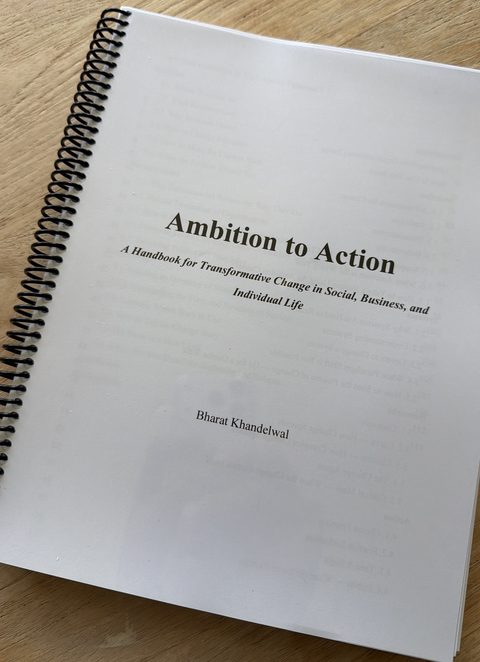
Ambition to Action

Book · framework · app

Ambition to Action — the bound manuscript

A handbook for transformative change in social, business, and individual life.

A handbook for navigating change, where I compile 30 years of personal experience, the best research from 150+ studies, and ideas from the best thinkers.

StatusManuscript complete
CompanionThe A2A app — live

We Are Not a Family

Book · podcast

WE ARE NOT A FAMILY BHARAT KHANDELWAL

Work like a pro sports team: a guide to sustained success.

Inspired by the 2009 Netflix Culture Memo by Reed Hastings and Patty McCord: how companies, and the people working in them, are better served by dropping the metaphor that they are family. Learnings from pro sports teams on sustained success.

StatusIn progress
Working with AI

Measured field notes from production systems and prompting studies

Videos

Voices Raised

Celebrating women in STEM · concept and creative director

Time of The Unseen

Poetry & video · writer, narrator, and concept

Fashion industry articles and videos

Growth

Product and assortments

About

Quiet introspection and lively conversations.

Contact bk2022@gmail.com Elsewhere LinkedIn
Reading
Learning
Sharing
Design
Architecture
Products
Weights
Yoga
Meditation

I love business. Creative destruction of businesses, through technology and market forces, is natural. I have built a life and career navigating this change.

My vices are buying more books than I can read, and talking to everyone about what I am reading. My mentors are Charlie Munger on business and life, Lee Kuan Yew on pragmatism, Donella Meadows on systems thinking, and Don Norman on design; I have met them only through their books, videos, and work.

I live between Manhattan and Princeton.