From the token to the boardroom
The whole AI stack, built and run live.
Operating doctrine
AI compounds only when it changes how the company works
The claim
I build AI-based operating models that turn scattered experiments into enterprise capability.
Most companies begin with use cases, copilots, and chat licenses. The harder work is building the AI operating system underneath: making the organization machine-legible, preparing workflows for agents, and defining how trust, decisions, and accountability work when humans and machines share decisions.
I bring systems thinking, decades of transformation experience, and hands-on AI depth across product, architecture, evaluation, and deployment.
Knowledge systemsGraph RAG, authored corpora, retrieval, reranking, and cited answers.Make enterprise knowledge queryable, traceable, and useful for decisions.
Trust systemsEvaluation layers, seeded defects, fabrication checks, human gates, and telemetry.Trust is engineered through judgment and protection, not assigned to the model.
Operating modelAIOS, Navik, workflow redesign, agent accountability, and governance as a spine.Value accrues when AI changes how work, decisions, and responsibility move.
The force
Like the industrial revolution, AI will unleash massive change, with three differences
SkillsThe industrial revolution mechanized the production of goods, but specialization and skills kept their value. AI automates, augments, and even eliminates intellectual and creative tasks.Embrace the silo-busting as agents scour everything in the servers and get better than humans at decisions, as happened with chess; the role of managers and office workers changes.
PaceSteam power, electricity, and machines gave people decades to adjust. AI adoption will be compressed, with the motivated few taking an enormous lead.Experiment at pace, walk away from the sunk costs of failed experiments, and switch rapidly to improved tools.
PeopleThe industrial revolution moved labor, but apprenticeship and mentorship still carried knowledge from master to apprentice. AI makes that transfer opaque, and tacit knowledge shrinks.Develop operating models where the human ability to judge, critique, and act is preserved even as direct experience keeps reducing, like the ability to read a paper map.
Core capabilities
Eight capabilities, learned by building
1 · The Model
Task-fit intelligence
BuiltWorked hands-on across every model type: large and small language models, vision, embedding, and OCR, including open-weight models run locally on my own Mac (a Qwen vision model and a 30-billion-parameter Qwen). Each system was built around the one that fit the task, not the biggest available.
StudiesRead a 189-book shelf with five open-weight vision models, same prompt and scoring, changing only the model. The biggest model was not the most accurate, and what separated a safe model from a risky one was its fabrication rate (how often it invented a book that wasn't there), not its raw score.
LearnedChoose a model by the task and by how it fails, not by its size or its score. The biggest model is not the safest: one that fabricates confidently is more dangerous than a smaller one that admits it doesn't know.
2 · The Engine
Deterministic, hybrid, traceable
Builtanti-library.ai turns my ~1,200-book personal library into clusters of books that share ideas. Ask an LLM to build those clusters and it draws them differently every time. So I built the clustering engine as a hybrid: the LLM reads the ideas, but deterministic rules and vector similarity form the clusters, so the same input returns the same, traceable result every run.
StudiesI put the pure LLM and the hybrid side by side and measured how far the clusters moved between runs. The LLM's moved constantly; the hybrid's did not move at all.
LearnedReliability is not something you can prompt out of a model; it is something you engineer around it. A frontier model will not hand you dependability. The structure you build will.
Field reportWhen similarity became geometry — why a frontier model could not group thousands of claims reliably, and how an embedding model gave the search a fixed frame.
3 · The Lens
Coverage over canon
BuiltPoint an AI at a library, and it inherits three biases at once: it favors American authors, Western traditions, and famous names. I corrected this at the structural level: I designed a lattice drawn from international library classification systems, so coverage across geographies and traditions is enforced by design, keeping my own taste out of it.
StudiesOn top of that lattice I ran a farthest-first search that walks to the most distant, least-alike books first, so the periphery gets sampled before the canon. Tested blind against seven idea-threads I'd sealed in advance, it rediscovered five, where the earlier version, which ranked books by citation weight and Wikipedia legitimacy, had found none, and it turned up three threads I'd never named, one spanning Roman, Persian, Confucian, and Japanese traditions.
LearnedThe bias in AI discovery hides in the very signals that make things findable: citation weight, popularity, and canonical status all pull toward the same famous few, so any system that ranks by them will mistake fame for importance. To get complete and cosmopolitan answers, you have to deliberately seek out the distant and the less-legitimized, scouring the areas a fame-ranked system overlooks.
4 · The Harness
Metered, cheap, swappable
BuiltA demo that works once tells you nothing about what it costs to run every day. I rebuilt anti-library.ai behind a harness that logs every model call's tokens, cost, time, and GPU use to a single ledger, re-runs only the books that changed instead of the whole library, and treats the model as a swappable part, so a better one drops in as it arrives without rebuilding the system.
StudiesBecause every model call is metered to the ledger, I can see exactly where the cost concentrates and go after it. On Canon 100, a project that renders 100 major research papers into sketches, I cut the expensive drawing stage about ninefold, from a median of 105,000 tokens per paper to 11,000, by moving the ideation out of the drawing step and reusing work instead of regenerating it.
LearnedThe cost of a looping AI job is driven by the same context being repeatedly read. Modularizing and staging the work, plus smart use of caching, can significantly reduce costs.
StudyWhere the Tokens Go — what 6,249 production calls taught me about tokens, caching, and prompt design.
5 · The Evaluator
Independent, layered, human-gated
BuiltBuilt Parakh, an evaluation layer that assays the work at every stage of anti-library.ai: collect, classify, churn, curate. Independent agents run checks at each step and evaluate the outcomes from different angles. Further, I added a human evaluation layer.
StudiesTo test the checker, I first planted a known false unit and confirmed it caught it, then ran it across 724 books and 3,468 idea-units. It flagged 26, including real fabrications the model had made up, like tagging one Dawkins book with the central metaphor of another.
LearnedTrust in AI has to be built through independent evaluation. AI hallucinates, and even a checker that checks the original work can have errors. A layered assay is important for catching errors and building trust. At the final stage, human-in-the-loop is still useful, particularly when dealing with problems where there isn't a deterministically correct answer.
6 · The Interface
Beautiful, clear, delightful
BuiltLagom restrains AI's synthetic, garrulous writing, refining ideas and words together toward a measured economy. A second system, AI and Beauty, draws on rules from four thinkers and nudges the AI into creating beautiful visuals on its own. And napkinsolo.ai turns complex material into something accessible and fun to read.
StudiesRather than prompt the AI for each visual, I wrote rules and let it draw on its own: one rule set from four thinkers on beauty, another for emergence that grew a book collection into a garden. The rules generated ideas and carried them at least 75% of the way to visuals that land with real wow; the rest I developed.
LearnedAI's ability to build taste, a sense of beauty, and aesthetics is still evolving. Yet AI can be nudged in the right direction with a set of simple rules rather than elaborate or restrictive prompts.
7 · The Trusted Answer
Graph RAG over a hand-built corpus, measured at every stage.
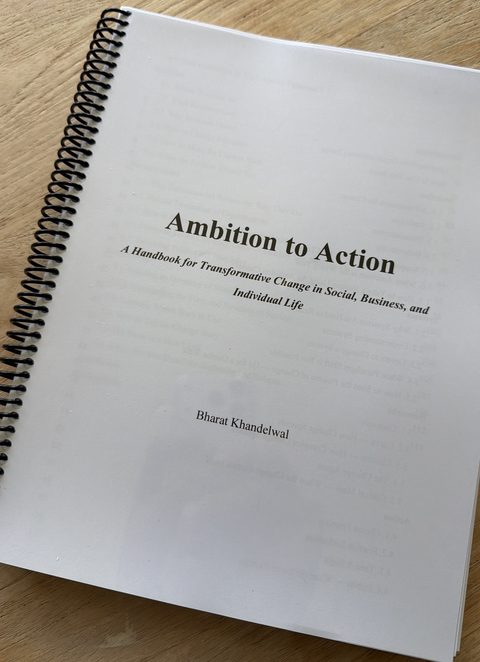
BuiltAsk-A2A, a graph RAG engine over my handbook Ambition to Action and the research base behind it. I rebuilt the corpus by hand: one idea per card, each card written to be found, each linked into a knowledge graph of concepts, researchers, and book passages. Retrieval is hybrid, reranked by a model, and expanded through the graph. The book frames each answer, the research supports it, and every source is shown.
StudiesReplaced 1,521 machine-cut chunks with 475 authored ones and measured the difference: concept cards went from 3.1 to 5.8 graph neighbors each, and none was left isolated. A listwise reranker raised mean reciprocal rank 24 percent and put the right source first on 82 percent of eval queries, up from 51. The stopwatch then found a surprise: the reranker spent 53 seconds thinking per call. Dialing its reasoning down cut that to 14, at a measured cost of five points of accuracy.
LearnedRAG quality is decided before retrieval. Chunks authored as single ideas beat clever search over scraped text. Downstream, every stage must earn its place twice, once on quality and once on the stopwatch: the stage that helped most was also the one that cost the most time.
8 · The Boardroom
Value accrues only when the operating model changes and AI becomes integral.
BuiltAn AIOS framework for adopting AI across an organization, past the usual list of short-term use cases. Reframed the board's question from use cases that pay off immediately to incrementally building a foundation that carries a decade of change. Mapped the new roles that emerge in an organization, and the work of managing agents alongside people.
StudiesAssessed how 10+ organizations outside technology and finance are adopting AI, and found nearly all stuck in one of two early stages: giving staff an assistant like Copilot or Claude, or buying select AI tools from vendors. None had begun to rebuild the company around a machine-readable operating system. The barrier was rarely technology; it was a lack of deep understanding and long-term view.
LearnedThe paradox: you need a long-term view, and fast, reversible experiments to get there. When technology is emerging fast, you have to get on the learning curve and yet walk away from the sunk costs of failed experiments.
Principles
How I build
The bar
A capability counts only when I can build it and explain it from first principles.
On its own the model is unreliable, so the reliability has to come from the system around it. Measure every step, then improve by cutting whatever the data shows is dead weight. Ensure trust and quality through a multi-level assay system. Use human judgment where it matters.